Nouvelle Bug: Bonheur Suprême’s Homunculus and the existential geography of the digital landscape
There are images that resist time, but not space — not because they carry an absolute truth, but because of the force with which they assert themselves in our imagination.
Homunculus (2024), a short film made by Bonheur Suprême during the Nouvelle Bug residency, moves precisely along this ridge: it deconstructs the geography of the video game to open up a reflection on identity formation and the power of imagination. In a landscape designed for epic feats and domination, disorientation emerges
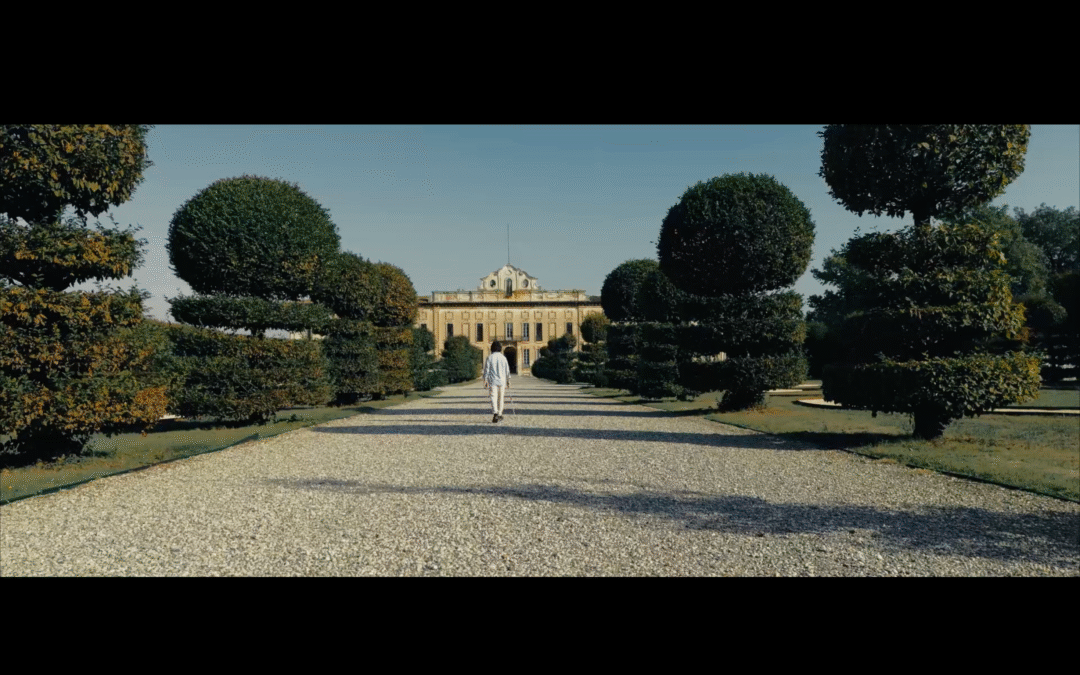
Filmed entirely within Skyrim, a video game marked by a strong epic and identity imprint, Homunculus transforms a space designed for conquest into one of contemplation and disorientation. An unnamed character wanders through mists and valleys, accompanied only by solitude — a mimesis with the landscape through non-action. There is no plot in the traditional sense: the act of walking itself becomes the narrative voice. And in this disarmament, a crack opens.
In the film, the romantic aesthetic of the digital landscape — pristine vastness, endless skies, solitary heroes — is subverted.
Stripped of its active function, the avatar becomes a poetic and vulnerable figure: an inappropriate, foreign presence that disrupts the world’s coherence and reveals it for what it truly is.
Not through action, but through observation, he allows the world of Skyrim to manifest itself as it is
The walking man is perceived as “Arab.” Not so much because of what he is, but because of how he is looked at. Bonheur Suprême explores how bodily otherness is loaded with foreign meanings, from erotic fantasy to political surveillance to colonial mythology.
To walk with its protagonist is to suspend judgment, to inhabit the void, to question the image — and perhaps even our own reflection in the mirror. Homunculus was born from a trivial yet revealing episode: a message received on Grindr from a stranger, thrilled to speak to an “Arab.” From that moment, Bonheur Suprême chose to use machinima not to tell a story, but to interrogate the system of images itself.
The film shows us that even in the most saturated spaces, in already-occupied territories, there lies the possibility of deconstruction — aimed at liberation.
The artist, French-born in 1994, has long worked with digital imagery: video games, dating apps, avatars. His research explores the forms of desire and violence that surface in spaces where the body is no longer flesh, but simulacrum.
Homunculus — awarded at Visions du Réel — is both a culmination and a new departure.
We had the pleasure of speaking with it — virtually.

How did Homunculus come to life? What was the starting point that led you to explore these themes through the language of machinima?
Bonheur Suprême
It all started right after a conversation with a stranger on Grindr. The guy was really happy to be talking to an “Arab.” When I asked him, “What does being an Arab mean to you?”, his answer left me speechless. He described, in detail, a phantasmagorical character, to whom he attributed innate qualities — a depiction almost straight out of One Thousand and One Nights. I felt like he was drawing, on my body, the contours of a mythological Arab, shaped by a pornographic and post-colonial history 1.
At the same time, it awakened intimate questions I had about my own Algerian heritage. I decided to explore all these questions through a film — the idea of which was born right then.
You chose Skyrim as the visual setting for your film. What drew you to this videogame, and how did you work to turn it into a narrative space that reflects your themes?
Bonheur Suprême
I was drawn to this game for several reasons.
The first is the unique relationship it offers with other players. When watching a machinima, a video game player sees images from a universe they’ve already invested hundreds of hours in. It’s interesting to contrast the performative dimension — whether competitive or theatrical — of gameplay with the contemplative stance of a spectator.
Then, it’s precisely because of this performative and theatrical aspect that I chose to use a video game to address the figure of the “Arab”: a fictional character, who exists only in racist imaginaries, invented to satisfy colonial paradigms.
Moreover, the game is well known for its “Viking” aesthetic, which is particularly appreciated by far-right and masculinist communities. The lore of Skyrim itself is shaped by a civil war, steeped in identity-based and xenophobic conflicts. I especially enjoyed using mods to strip down these hyper-masculine warriors — mostly designed by (straight) men for (straight) men — and staging them in search of the “powerful” Arab body, even more masculine than theirs, exposing the grotesqueness of such a situation.

You worked with a medium originally designed for entertainment, stripping it of action and competition. What remains when you remove the “game” from a videogame?
Bonheur Suprême
What remains is everything that was already there – but obscured by the frenzy of performance and action: the landscapes, the sounds, the light; and the digital entities, puppets simulating a form of life through an experience simulating a form of existence.
I wonder about the possibility of adopting a romantic stance within these virtual spaces. I try to anthropomorphize my avatars by portraying them as vulnerable, sad, in love — to invite the viewer’s empathy toward them, and thus question the limits of video game immersion: to what extent can the spectacle replace real experience? Can it sometimes surpass it?
I also work with dating apps. And I ask myself the same questions there. How does the interface distort our perception of reality, and restrict our relationships to others and to ourselves? How do we exist as text, as photos — which themselves are subject to exclusionary aesthetic norms?
This regime of images, mediated by interfaces — which we all swim in today — tends to distort or even invert a reality that is becoming increasingly unstable. The message I received on Grindr is one example: the expression of a damaged reality, fictionalized by its own absurdity. That’s why I found it interesting to talk about video games with Grindr, and vice versa.

Your avatar is perceived as “Arab,” but it seems you want to deconstruct that projection from within. What does it mean for you to inhabit an identity that is assigned to you?
Bonheur Suprême
It’s because I position myself, in terms of identity, between two paradigms: my French mother and my Algerian father. And that forces me to draw lines, set boundaries to define these two terms — benchmarks that, lacking better options, follow a racist logic: where does the “Arab” begin, where does the “French” end? What is an “Arab” in post-colonial France?
Throughout my life, I’ve actually experienced very little racism. People don’t immediately identify my Algerian origins, unless I tell them. So I experience fetishization from a detached, safe position. I place my body in the virtual public space, just like I place my avatar in the plains of Skyrim —to observe how the world interacts with that surface.
In the film, following this logic of surface, I wanted each figure to become only what they appear to be: the white gay man, the police officers, the rebeu (slang term for “Arab”)—and for nothing to remain beyond these roles, these floating, assigned identities, reduced to the function of characters.
I really like Paul B. Preciado’s reflections on identities, which he claims are “nonexistent.” In one of his texts2, he argues that in recent decades, struggles for equality have sometimes frozen the very differences they sought to overcome. On the other hand, conservative forces have seized upon them to exclude others in the name of supposed legitim identities. But these identities, while nonexistent in themselves, produce very real social and political effects.

How was your experience at the Nouvelle Bug residency and how did it influence the making of the film?
Bonheur Suprême
Nouvelle Bug was a very unique experience. It’s a chance for lovers of new media of all kinds to come together and share ideas around emerging creative tools, like video games and artificial intelligence, surrounded by talented artists. We were able to test the limits of these tools in a collaborative, chill, and supportive atmosphere.
And in the end, we all made a film — which is extraordinary given the short time frame, and with nothing but a computer! I’m sincerely grateful to Andrea, Marco, and all the other members of the Il Varco and Gargantua teams, who make this opportunity possible for young artists like me.
Do you believe there is a political responsibility in portraying the virtual? And if so, where does one begin to take on that responsibility?
Bonheur Suprême
Yes, even though video games have now become widespread, they remain steeped in ideologies that shape aesthetics and define what is possible in very particular ways.
For example, in many video-games, the core gameplay revolves around conquest, killing, optimizing to grow — at the expense of the living and non-living world, which is turned into a battlefield-landscape, reduced to an obstacle to overcome or a resource to exploit.
In times of social and climate crisis, it’s urgent to question these representations, and to use video games — this incredible world-making medium — to depict reality in an inclusive way and generate desirable futures.
To conclude, I’d also like to quote Andrea Gatopoulos, artist, author of the Cyber-realism Manifesto, who writes: «The virtual is a part of the dynamic reality, which has always existed and is constantly evolving […] Failure to analyze the virtual with artistic and cultural means [is] handing over its keys to interested and violent powers»